
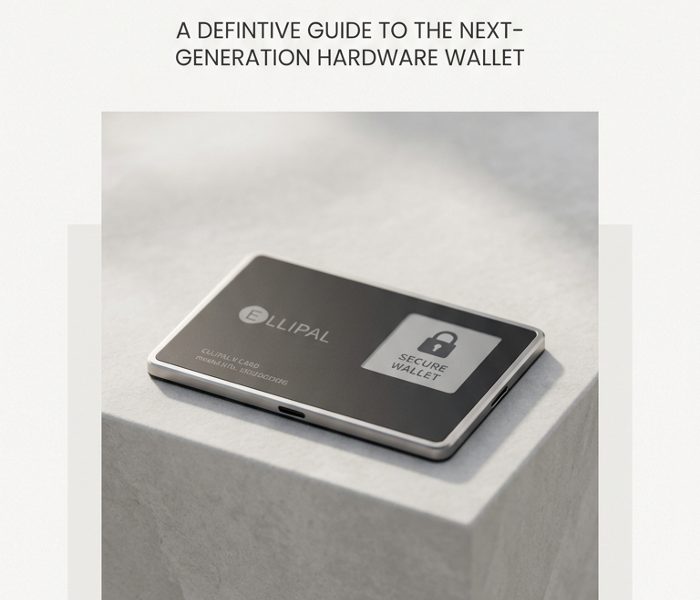
Ellipal X Card Cold Wallet Review: A Security and Usability Breakdown
In the self-custody landscape, hardware wallets have evolved from bulky USB-like drives to sleek, card-shaped form factors. The Ellipal X Card is one of the latest entries in this category, offering a credit-card-sized cold storage solution that utilizes Near Field Communication (NFC) to interact with mobile devices. This review provides an objective, institutional-grade analysis of the Ellipal X Card, evaluating its security architecture, integration with the Ellipal ecosystem, transaction liquidity, and overall cost-efficiency.
Executive Summary & Overall Rating
Based on our multi-dimensional evaluation framework, the Ellipal X Card scores 83/100, earning a Tier 2 (Robust & Secure) rating. While it offers excellent portability and a highly competitive price point, its reliance on proprietary firmware and third-party swap providers prevents it from reaching Tier 1 status.
Core Pros & Cons
- Pro 1: High-grade physical security featuring a CC EAL6+ certified secure element.
- Pro 2: Convenient, battery-free NFC connectivity that eliminates the need for USB cables or Bluetooth.
- Pro 3: Seamless dual-mode management within the companion app, allowing users to run a cold wallet alongside an ellipal hot wallet.
- Con 1: Proprietary closed-source firmware, making independent security audits of the code difficult.
- Con 2: Higher transaction fees and slippage when using the integrated in-app exchange features.
- Con 3: NFC range and compatibility issues can occasionally occur with older smartphone models.
User Profile Match
The Ellipal X Card is best suited for mobile-first crypto investors and retail traders who prioritize portability and want a budget-friendly cold storage backup. It is less ideal for high-frequency institutional traders or open-source purists who require fully auditable codebases.
—
Asset Security & Hardware Architecture
The core value proposition of any cold wallet is its ability to isolate private keys from internet-connected environments. The Ellipal X Card achieves this via a CC EAL6+ certified secure element, which is the industry standard for financial-grade smart cards and passports. This chip is designed to resist sophisticated physical attacks, including side-channel analysis and grid probing.
Unlike the flagship Ellipal Titan, which uses an air-gapped camera and QR code mechanism, the X Card relies on NFC. While NFC is technically a wireless transmission protocol, its range is limited to a few centimeters, making remote interception virtually impossible. The private keys are generated on-card and never leave the secure element during transaction signing.
However, from a trust-minimization standpoint, Ellipal’s firmware remains closed-source. While the company has undergone external security audits, the lack of a fully open-source repository means users must trust Ellipal’s cryptographic implementation. Backup is managed via a standard 12 or 24-word recovery phrase (BIP-39), which must be written down manually and kept offline.
—
Compliance, KYC, and Privacy
As a non-custodial hardware wallet, the Ellipal X Card does not require any Know Your Customer (KYC) verification for basic setup, wallet creation, or receiving assets. This provides a high level of privacy for users looking to maintain control over their financial data.
However, compliance requirements apply when interacting with the fiat-to-crypto gateways integrated within the ellipal x card app. When purchasing crypto using credit cards or bank transfers, third-party providers (such as Banxa, MoonPay, or Simplex) enforce strict KYC and Anti-Money Laundering (AML) checks in compliance with local jurisdictions like FinCEN (US) and MiCA (Europe). The wallet itself remains neutral, acting merely as an interface for these regulated gateways.
Integrated Exchange Liquidity & Swap Performance
While the Ellipal X Card is primarily a storage device, its utility is heavily dependent on the swap features built into the mobile application. In this ellipal wallet review, we analyzed the liquidity and pricing of the integrated swap engine.
Ellipal aggregates liquidity from various decentralized exchanges (DEXs) and centralized swap partners (like Changelly and ChangeNOW). For major pairs such as BTC/ETH or ETH/USDT, the order book depth is sufficient for retail amounts, with execution slippage typically staying under 0.5% during normal market conditions. However, during periods of extreme market volatility, slippage can widen significantly, and transaction failures may occur due to network congestion on the host blockchains. For large-volume trades, users are advised to transfer assets to a liquid centralized exchange rather than swapping directly inside the app.
Fee Structure & Product Ecosystem
The Ellipal X Card is highly competitive on price, usually retailing around $39 to $49, making it significantly cheaper than traditional screen-bearing hardware wallets.
Within the ecosystem, the companion app allows users to toggle between their cold storage accounts and a software-based ellipal hot wallet. This dual-setup is convenient for keeping a small amount of “spending money” in a hot wallet for quick dApp interactions while keeping the bulk of assets secured by the physical card.
The primary cost drawback lies in the transaction fees of the integrated swap service. On top of standard network gas fees, third-party swap providers charge convenience fees ranging from 0.5% to 2% per trade. Staking is supported for major Proof-of-Stake (PoS) assets like Cosmos (ATOM) and Tezos (XTZ), offering native yields directly through the app interface.
UX, App Connectivity, and Support
The user experience of the ellipal x card app is clean and modern. To sign a transaction, the user initiates the transfer in the app, taps the physical X Card against the back of their NFC-enabled smartphone, and inputs their security PIN. The process is faster and more convenient than typing on small hardware wallet screens or dealing with cables.
The app integrates TradingView charts for basic market analysis, which is a welcome feature for retail users. On the downside, customer support is limited to email tickets and a basic help center. Response times typically range from 12 to 24 hours, which is standard for the hardware wallet industry but lags behind the real-time support offered by major crypto exchanges.
Is the Ellipal X Card Worth It?
The Ellipal X Card successfully bridges the gap between cold storage security and mobile convenience. By utilizing NFC technology and a CC EAL6+ secure element, it offers robust protection against digital threats in a highly portable card format. While the closed-source nature of the firmware and the higher fees on integrated swaps are notable drawbacks, it remains an excellent, cost-effective entry point for secure self-custody.
